
In Japanese language, adjectives are classified into two categories: い-adjectives (i-adjectives) and な-adjectives (na-adjectives). Their main function is to describe the characteristics of a noun or pronoun.
い-adjectives are adjectives that end in the syllable “い”. These adjectives can directly modify nouns without the need for a particle.
かわいい – cute / かわいいいぬ – cute dog
おおきい – big / おおきいへや – big room
あたらしい – new / あたらしいシャツ – new shirt
おいしい – delicious / おいしいりんご – delicious apple
Example 1
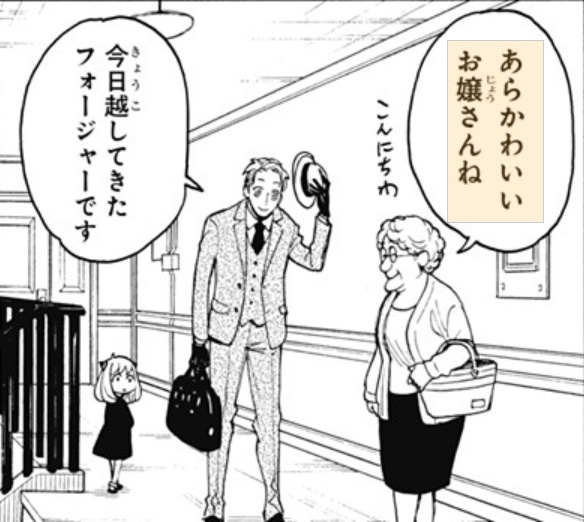
あらかわいいおじょうさんね。Oh, what a cute girl.
Spy x Family Volume 1 Chapter 1 page 25
Conjugating い adjectives in a plain form
Present form: い-adjective. Example: 冬(ふゆ)はさむい。The winter is cold.
Past form: い-adjective – い + かった. Example: 冬はさむかった。The winter was cold.
Present negative form: い-adjective – い + くない. Example: 冬はさむくない。The winter isn’t cold.
Past negative form: い-adjective – い + くなかった. Example: 冬はさむくなかった。The winter wasn’t cold.
Exception: adjective いい
いい – It is good; よかった – It was good;よくない – It’s not good; よくなかった – It wasn’t good
な-adjectives are adjectives that end in the syllable “な”. These adjectives need the particle “な” to connect them to a noun, but it is omitted when the adjective is placed after a noun.
きれいな – pretty / きれいなはな – pretty flower
しずかな – quiet / しずかなへや – quiet room
たいせつな – important / たいせつなひと – important person
きけんな – dangerous / きけんなへん – dangerous area
Conjugating な-adjectives in a plain form
Present form: な-adjective + だ. Example: 花がきれいだ。The flower is pretty.
Past form: な-adjective – な + だった. Example: 花がきれいだった。The flower was pretty.
Present negative form: な-adjective – な + じゃない. Example: 花がきれいじゃない。The flower is not pretty.
Past negative form: な-adjective – な + じゃなかった. Example: 花がきれいじゃなかった。The flower was not pretty.
 365 Nihongo