
The particle の is a very versatile particle in Japanese grammar. One of the most common uses is to indicate possession. It is often translated into English as “of” or “s.”
Form: Noun + の + noun
Example 1: 私(わたし)は姉(あね)の結婚式(けっこんしき)に行(い)く。- I am going to my older sister’s wedding.
Example 2: 日本語(にほんご)の文法(ぶんぽうは難(むずか)しいです – Japanese grammar is difficult.
の can also be used for description where a noun describes another noun.
For example: 世界(せかい)の平和(へいわ) – world peace.
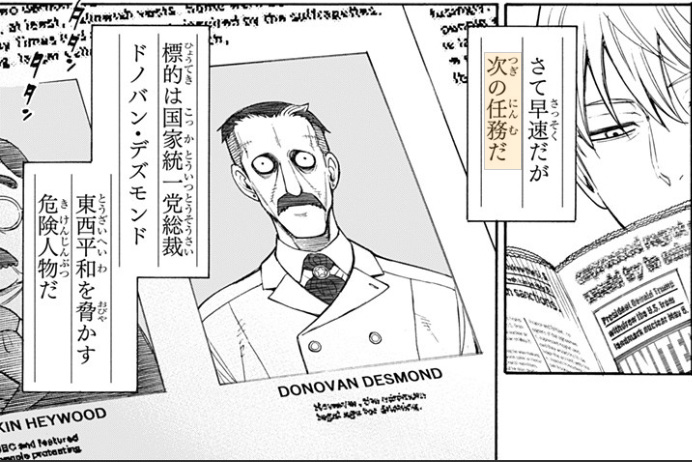
Example 3: さて早速(さっそく)だが次(つぎ)の任務(にんむ)だ – Without further ado your next mission…
Spy x Family Volume 1 Chapter 1 page 13
When added at the end of a pronoun, the pronoun changes to possessive pronouns or adjectives. For instance, 私(わたし) – I, 私の – my/mine; 彼 (かれ) – he, 彼の – his/his.
 365 Nihongo