
The Japanese topic marking particle は (pronounced “wa”) is a crucial grammatical particle in Japanese that is used to indicate the topic of a sentence. It is often one of the first particles that Japanese language learners study, as it is used frequently in conversation and writing.
In Japanese, the topic of a sentence is often introduced with は, which is usually placed at the end of the topic phrase. For example, in the sentence:
私(わたし)は学生(がくせい)です。- I am a student.
The topic is “私”, meaning “I,” and it is marked by the particle は; the rest of the sentence gives information about the topic.
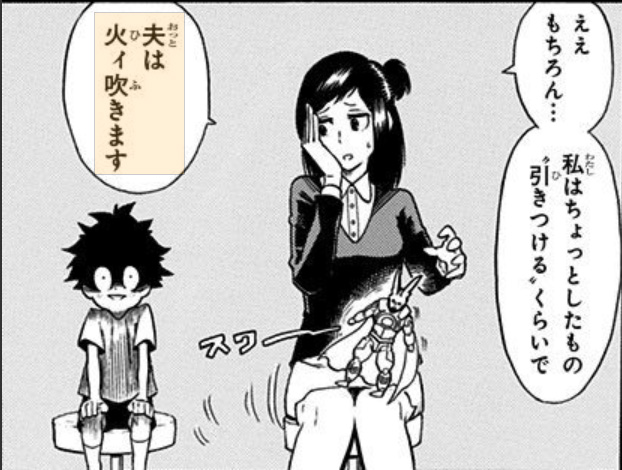
Example 1: 夫(おっと)は火(ひ)吹(ふ)きます。- My husband emits fire. The topic is 夫 (husband), as she is talking about her husband.
MHA Volume 1 Chapter 1 page 23
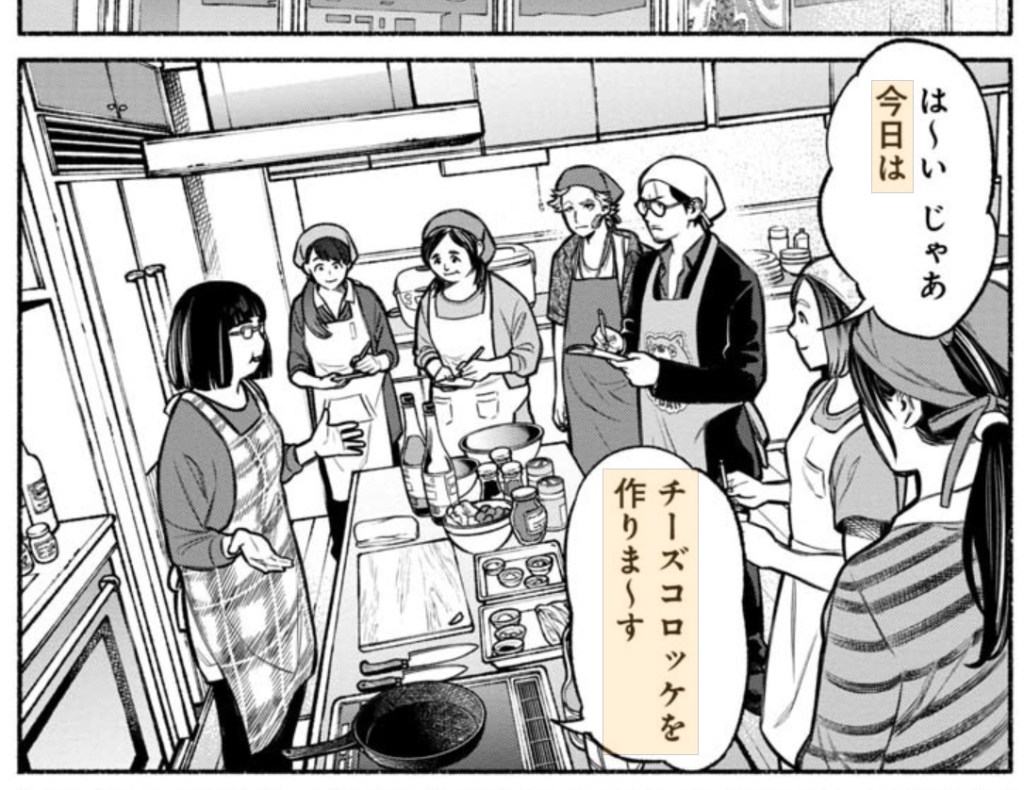
Example 2: 今日(きょう) はチーズコロッケを作(つく)ります。- Today we are making cheese croquettes. The topic is 今日 (today), as the lady explains what will be happening today.
The Way of the House Husband Volume 1 Chapter 3 page 38
The use of は can vary depending on the context and the speaker’s intention. For example, it can be used to contrast the topic with something else or to emphasize a particular aspect of the topic. It can also be used to mark a topic that is already known or to introduce a new topic.
One thing to keep in mind is that the particle は is not equivalent to the English word “is” or “am”. Rather, it is a grammatical particle that marks the topic of a sentence. It does not indicate a verb or an action, but rather provides a way to identify what the sentence is about.
 365 Nihongo